
For many years the Cooks have linked with the Mercers, Masons, and Broderers for shared events and shared charity.

This year it is the Broderers’ turn to pick a recipient but there is a vicarious benefit for the Cooks as the charity of choice is the Museum of London, hard by the block on the site of the Cooks’ Hall.
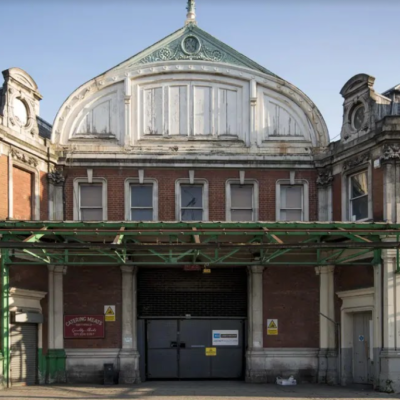
The Museum of London is scheduled to relocate to a new site at West Smithfield next year. This site covers the old fish, meat and poultry markets and will include shops and cafes, forming a key component of a new “cultural mile” in the northwest part of the City. The Museum will eventually be served by the new Elizabeth Line as well as the existing Farringdon station.
Planning permission has been granted. As at July 2020, the budget for relocation was set at £337 million of which over £290 million has already been raised.
The Museum of London team have determined there will be four permanent historic galleries focused on four key aspects of London:
- a gallery that tells the chronological history of London
- a purpose built gallery to display the Cheapside Hoard. Discovered by workmen in 1912 below Cheapside, it is the largest cache of Elizabethan and Stuart jewellery ever found – and currently not on public display. This gallery will also include 17th century London trades and manufacturing.
- A gallery focused on the “physical” city – the built environment and the natural environment
- A gallery about London life; living or working in London in more recent times
Cheapside in the 17th century was a principal shopping street in the City of London, as well as the hub of the goldsmiths trade. The Cheapside Hoard is the stock-in-trade of a working goldsmith. In this period, clothing was acceptably used to display wealth, using expensive textiles, frequently with exquisite embroidery and metal threads.
The museum is keen to use its collections to highlight 17th century London Life and the various trades that would have been patronised by the wealthy. It has the second largest collection of historic textiles in Britain after the V&A. Many of these textiles are unsuitable for display, while others require varying amounts of conservation and or mounting before they could be displayed in the new Museum.
Working with the Museum, the Broderers have identified items that highlight a wide variety of embroidery techniques and applications that would form the content of three display cases. No commitments have been made and the MoL clearly understands the process by which the recipient of the joint award will be determined.
Conservation work is estimated to be a minimum of 425 hours with the total cost including mounting to be £21,250.
All the work will be carried out by the museum’s own textile conservators who are part of a training programme for student conservators on placement from university conservation courses. Recently, the Museum has supported schemes helping to diversify the profession and have hosted two Culture& New Museum placements in collection management and care.


