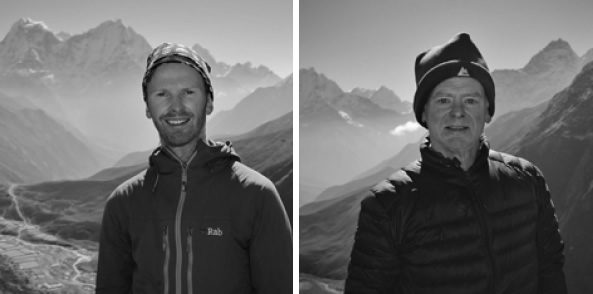
The voice of the Mother Abbess soared as she implored the errant Maria to ‘climb every mountain, ford every stream, follow every rainbow, ‘till you find your dream’… so a young Graham Puxley hoped to fulfil his dream of one day climbing his mountain to reach the heady heights of Everest Base Camp – some 17,500 ft above sea level!
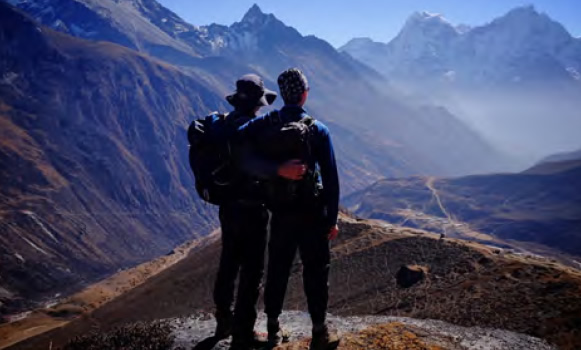
Each year, he religiously collected brochures from adventure experience companies (he still has a huge stack at home) and every year there was a reason not to go – couldn’t afford it, pressure of work, young child – and so the stack of brochures continued to grow until extensive medical tests revealed a shock diagnosis of Alzheimer’s. While still reeling from the implications of this devastating news, son Chris urged Graham to act. After all, he reasoned, Dad wasn’t getting any younger and, in the words of the infamous sport brand, challenged him to ‘just do it’.
Chris explained “I am a great believer that if you fix things securely in your diary there’s more chance of it happening – and this time, to make sure, I offered to come too”. For Graham, the prospect of undertaking the challenge with Chris was special and concedes that without Chris’s prompt he would never have bitten the bullet.
With the expedition firmly in the diary, their fate was sealed. They booked with KE Adventure who carefully planned the trip and gave advice on the preparation, kit, and training required. Having lived in Cumbria for years, and with many friends there, it was a natural place for fell and hill training. Chris picks up the story, “When we booked the trip, Dad had been struggling with mobility, and there were natural concerns, but having this amazing goal and his determination in training, saw huge improvements”. Nevertheless, the enormity of the undertaking and the risks involved were never far from their minds.
With meticulous preparations complete, the trip loomed.
Emotions were high – massive excitement mixed with fear and sheer trepidation. There was no time to dwell on it, however, as they had to grapple with decisions regarding kit – they had to travel light, but also needed the essentials for the arduous trekking ahead and enough clothes not to be too smelly! Bags efficiently packed and off they went on their adventure.
Once in Nepal, they were immediately hit by the commotion, chaotic vibrancy, exotic smells, and general hullabaloo that is Kathmandu. Arriving at midnight, they had just three hours in their hotel room, before meeting up with the other members of their small group and embarking on a long road transfer to Ramechhap Airport. Despite the lack of sleep, they were kept on the edge of their seats (quite literally) during a particularly hair-raising, white-knuckle ride of a trip. Horns blared incessantly; vehicles careered all over the road; unusual overtaking manoeuvres were undertaken at speed, in the direct path of oncoming vehicles, somehow managing to avoid collision at the last moment; while yaks, bony horses, and other creatures wandered in and out of the traffic adding even more angst to the trip.
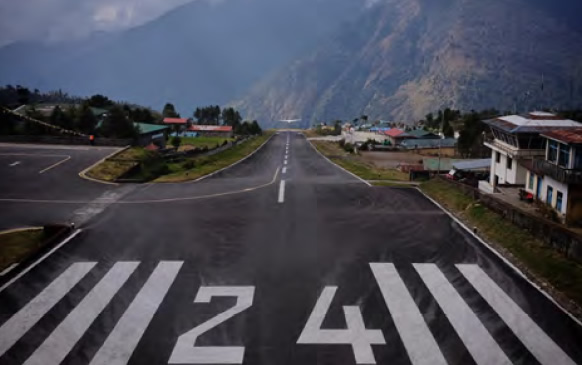
On arrival at Ramechhap, and somewhat alarmingly, passengers and luggage were all weighed before take-off, to ensure the plane was not overloaded and to give the pilot the best chance to land safely at Lukla – largely considered to be the most dangerous airport in the world!
This remote airport is surrounded by a steep, mountainous terrain. The short runway is perched on little more than a mountain shelf. At one end there’s a wall and at the other a steep drop into the valley below. A bulldozer is kept on the runway to clear away debris from crashed aircraft. Hearts were in mouths as the tiny aircraft was buffeted and blown as it came into land and the surrounding mountains loomed far too close for comfort out of the murky windows. This time it was a safe landing, and after hastily and thankfully disembarking, the relieved group headed immediately for a much-needed caffeine hit.
As they emerged from their coffee stop, breathing was already noticeably more difficult as they were already at over 2,600m. In the street, a line of yaks waited patiently, packed high with all sorts of provisions for the trip – rice, drinks, cooking equipment, and water. Before falling into step with the train of yaks, they met up with their Sherpas & crew. Graham enthuses “Sagrit and the team were incredible people, with their expertise and intimate knowledge of the mountains, their friendliness and care, we knew we were in safe hands – we could not have done the trip without them – they are a truly special group of people”.
Day 1 of this incredible adventure was now happening for real and the intrepid group quickly gained height from Lukla, already catching their breath because of the altitude, but looking down in awe on the incredible views surrounding the precariously positioned airport; marvelling at how planes managed to land there at all. Along the route, they came across simple, clean, mountain huts, offering superb service and fabulous food, that were set up and well looked after by retired Sherpas. As they were a small group by trekking standards, they were able to stay in small places run by locals. This was a fabulous opportunity, where they enjoyed the best hospitality – made even more remarkable because of their remote location.
Their first night was spent in Phakding and the following day, an 8-hour trek took them to Namche Bazaar (3,400m), the ‘Sherpa Capital’ – a lively trading post town forming a link between the mountains and the outside world. Here, Graham and Chris were at last able to get some rest and relaxation, as they spent the day wandering around, getting acclimatized, and visiting the Sherpa Museum, getting a sneak preview of its new wing. Chris described the museum as a real passion project for the people involved, celebrating the lives of Sherpas – from traditional living to becoming a destination for explorers and expeditions, celebrating the Sherpas’ many incredible feats, the obvious pride in Sherpa Tenzing but also the endeavours of hundreds of other remarkable Sherpas. What was abundantly clear was the Sherpas’ belief that the imposing mountains were to be honoured, admired, and revered.
By now, they were also getting to know others in their group which was down to ten as a couple had dropped out at Namche Bazaar after struggling badly with altitude. A stark warning that this was going to be no easy feat.
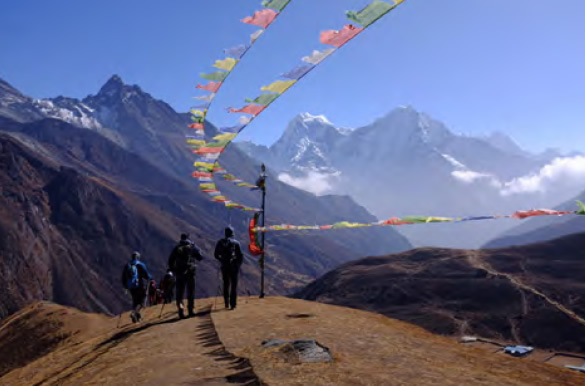
Next morning, feeling refreshed, the remaining group trekked through the Sherpa villages of Khumjung and Kunde to Kangjuma, which gave them their first distant but nevertheless spectacular views of Everest, while looking down on a stream of white walls and green roofed buildings. At Khumjung, they visited a school where they were able to say hello to the children and give gifts of pens – a simple gesture which was received with so much joy, you’d think they’d been given the crown jewels!
By day 6, as they trekked to 4,000m at Dole, Graham and Chris were beginning to feel like they had spent their whole life in the mountains of Nepal and had got into the daily routine. Graham recalls every step was an effort but at the same time filled with wonder – incredible scenery, all sorts of wildlife, spectacular birds, and scampering monkeys. An experience to which none other compares – amazing sights, smells and putting one increasingly weary foot in front of another….and they hadn’t even touched snow yet! So far, they had been blessed with glorious weather (at that time of year, it could’ve been torrential rain and floods), but they experienced a consistent pattern of a bright start, a 3PM mist and a temperature drop in the evening – to about -5 – when a fleece was needed. Any washing at that time got quickly frozen!
Day 7 was a particularly nice, short, trekking day to Machermo – where they stayed in the Yeti Lodge Tea House – a Sherpa Hut visited by King Charles III, when he was Prince of Wales. Remarkably, there was a Sky connection, and the team watched the World Cup while enjoying the hospitality of a kind, Sherpa family. Extreme wifi links at the lodges meant essential contact could be made with family and friends and was a lifeline for people working on the trails – but there were no mobile phone signals at all.
The next day was another acclimatization day with a hike to a high ridge for views of Everest. Chris said “By this point, I was noticing that Dad was becoming a bit vague, but I just put it down to the effects of altitude; although I was aware that, as we ascended higher, his drugs would became less effective as they needed oxygen to work properly”. However, things seemed OK and the next day they headed off as planned to trek up to the spectacular upper part of the Gokyo Valley as far as the third lake at 4800m (15,750 ft).
They stayed in a lodge among more spectacular scenery, before setting off to climb to the summit of Gokyo Ri at 5360m. Both Chris and Graham knew this was going to be a testing day but had been looking forward with growing anticipation to the challenge. The aim was to rise very early, get to the summit before sunrise, head back down for a quick breakfast, before embarking on the glacier crossing for the next night’s stop at Dragnag.
Oh! the best laid plans…
Chris picks up the story “Even as we set off, I noticed Dad was not on his best form. We were progressing slowly, and I was becoming increasingly concerned. He was clearly struggling; he was not compos mentis and was slowly hauling one weary foot in front of another as if on a very laboured automatic pilot. By now, the rest of the group had disappeared into the distance, and we were trudging on alone with just Sherpa Sagrit for company.”
“I really did not think we were going to make it to the summit and was resigned to turning back. Every step took us higher, every step breathing became more difficult, but, somehow or other, Dad soldiered on, almost groping and clawing his way up. We carried on this way for hours. I really don’t know how he made it, even for me as a young, relatively fit man, it was the hardest thing I had ever done. But we made it to the top – an achievement and memory I will never forget”.
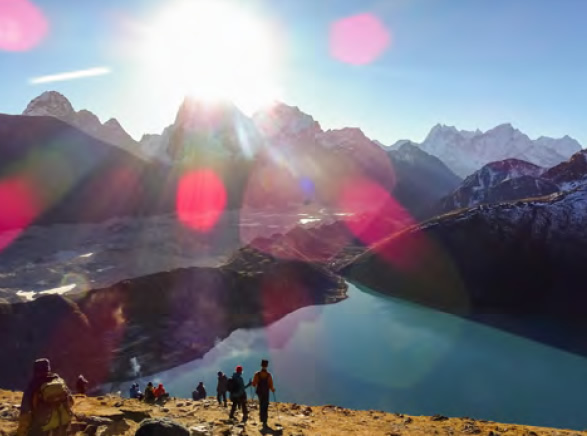
Graham recalled “We achieved the Gokyo Summit together. To say I felt completely wiped out, is an understatement – I was completely away with the fairies, hardly conscious, and utterly exhausted, but when we finally got to that summit, I just recall this feeling of utter elation. The views of Everest were simply breathtaking, and I remember a magical plume of snow, which looked as if it was trailing from the top of the Everest into the heavens above, while surrounded by an array of stunning 8,000m peaks as far as the eye could see, watching on. I knew at that moment, I had climbed my mountain, I had followed my rainbow, and by now, was definitely in a dream. I was completely spent and totally incoherent”.
Graham’s symptoms were due a combination of Alzheimer’s and the inability of his drugs to work properly without adequate oxygen levels and the hypoxia apparent before they set off had been down to this and the effects of altitude had seriously exacerbated the situation. However, the problem now was how to get Graham down safely, as his condition was deteriorating rapidly…
Graham continued “I have very little recollection of the way down – I just remember having my arms clinging around Sagrit and Chris’s shoulders – God knows how they ever managed to get me down”.
Indeed, part-way down, a frantic Chris was determined but trying to remain positive, there was still a long way to go, and he kept praying that they would make it back in one piece.
“Sagrit and I had been supporting Dad, and moving his feet with our feet, since the summit. We were trying to shoulder his weight, navigate the mountain terrain, and remain calm. We had been going for hours and making hellishly slow progress. I was shattered, the strain of literally hauling Dad down was physically and mentally draining, and all the time I was getting increasingly concerned about how we were going to succeed in getting back to base. Dad was unable to stand, he couldn’t see a thing, and he was half conscious and very confused. I don’t mind admitting I was scared stiff. Thankfully, Sagrit was unflappable. His reassuring presence was a godsend and without him I doubt we would’ve got down.”
“In the end, we were literally dragging him down the final stages of the mountain, every muscle and every bone in our bodies was screaming with pain and fatigue but, miraculously, through sheer willpower and resolve and with Dad’s underlying grit, we made it back to Gokyo Lodge and some welcome medical help”.
Gokyo was equipped with a medical centre and the expert team there determined that Graham’s blood pressure and oxygen levels were dangerously low. Overnight, while his oxygen returned to normal, it dropped back down again as soon as he was taken off it. His condition was still serious and, by now, they had taken the sensible decision to abandon the remainder of the trip. The rest of the group had returned as planned and headed off to cross the glacier and were unaware of the unfolding crisis. The challenge for Chris, Sagrit and the team was to work out the best way of getting Graham back to Lukla and the enhanced medical facilities there.
Clearly walking was not an option. Other possibilities were considered – but only briefly, including putting Graham on a horse! But, once Sagrit and the medical team had contacted the base in Lukla and explained the situation, they had no hesitation in despatching an emergency helicopter evacuation without delay. Within 40 minutes, Chris, Graham and Sagrit were airborne. Even in his deleterious state, Graham was mortified that Chris had had to cut the trip short. Chris, on the other hand, was having the experience of a lifetime as the helicopter flew through the Himalayas providing phenomenal views of these remarkable mountains, with only the sound of the helicopter blade breaking the eerie silence.
As they dropped altitude, Graham’s recovery was striking and, by the time they landed at Lukla, he was almost lucid! A medical check up showed that blood oxygen was already back to sensible levels, but a three-day observation was needed to monitor Graham’s recovery, before they would release him. The plan was to rest up and then return to join the group after their descent from Base Camp. But then, Chris got sick – whether altitude, whether the aftermath of the ordeal, or whether it was a bug – who knows, but it left Chris bedridden!
After three days, they decided to cut their losses and head back to Kathmandu. Easier said than done. Direct flights to Kathmandu were scarce and so they had to settle for a short flight to Ramechhap followed by that six-hour, bumpy, hair-raising, road trip back to the capital. They were booked into the very grand Hotel Shanker, an old colonial style building with a promise of hot showers and some welcome creature comforts. They were both extremely emotional but had an overwhelming sense of relief that they had returned safe and well.
For the next few days, they had time to explore the temples, spice markets, way of life and sights of the fascinating capital of Nepal as well as enjoying exciting tuk tuk rides. The fact that anything works in Nepal is astonishing. Chaotic wiring systems are draped hazardously along the streets, whole families are squashed onto scooters, dodging trucks, overcrowded buses, speeding tuk tuks and yaks, but this extraordinary array of functional chaos is served with a culture full of respect, friendliness, and warmth! Over relaxing meals and enjoying some wonderful Nepalese cuisine, they were able to reflect on the extraordinary experiences they’d had.
Naturally, What’s Cooking was keen to find out about the food and culinary delights of Nepal.
Graham recalled the ‘butchers’ shops’ where huge pieces of meat were piled on grim looking concrete slabs in the open doorways of shops, exposed to the heat of the day and the immense dust of Kathmandu (and it is incredibly dusty) with the butcher’s dog usually keeping guard on the table alongside yak meat, pork, and live chickens!
That aside, both Chris and Graham could not praise the food they received on the trip highly enough. Mo mo dumplings were a favourite but all the food they were given on the trek was simple, local produce, cooked by Sherpas in their homes, which tasted delicious whether it was lentils, soup, rice, veg stews – it was all food in season, that was locally grown.

Some of the hottest food they sampled was in Kathmandu. There were more chillies per square inch in their first restaurant meal, than they’d ever seen in a dish in their lives! That said, Nepalese food was tantalisingly tasty from the infamous Dal Bhat (Nepalese Thali) to Chatamari (spicy pancakes); Sekuwa (classic kebab) to Aloo Chop (potato fritters); and Choila (grilled water buffalo meat) to Sel Roti (deep fried doughnut) – all washed down with the odd drink of Raksi (tequila doppelganger).
With the trip ending, the pair headed back to England. and now, back to home comforts, can reflect on their achievements and experiences of this unforgettable place…
“When we first got back, the simple ability to drink water from a tap was a marvel” remembered Chris. “It emphasised to me that there are many places in the world which struggle to get easy access to an ‘essential for life’ we all take for granted. In Nepal, all our water had to be boiled before we could drink it and, in the mountains, it was difficult to get water to boil at all, so we had to resort to steritabs. To drink water from a tap when we got home was sheer luxury!
Graham recalled the endurance of the Sherpas and incredulity at the burdens the porters were able to carry including mass food supplies, cases of drinks and, in one extreme case, an industrial fridge freezer, while negotiating the same difficult, rocky paths that Westerners struggle up with the help of walking sticks and carrying next to nothing!
They both remember the streams of red, yellow, and blue prayer flags – depicting earth, wind, and fire – adorning suspension bridges over gorges and then walking across the same precarious suspension bridges, admiring the incredible feat of engineering required to build the bridge in the first place, while following in the footsteps of a yak or two! This also evoked memories of the infamous ‘yak squeeze’ – where you were advised to stick to the mountain side of the footpath otherwise the yaks, who were generally quicker and not inclined to wait, were in the habit of pushing anything in their way off the mountain.
Wonderful memories of an astonishing trip, but an important part of Graham and Chris’s endeavour was to raise money for Alzheimer’s Charity – the Just Giving site raised nearly £5,000 and Graham and Chris both emphasised the huge generosity of the Cooks. Graham has since given a talk in Stourhead, where they served Himalayan Goat Curry and raised a further £800. He is now on the WI circuit and in demand to deliver further inspirational talks and raise more funds.
Six months on, Graham reflects on an immense sense of achievement, the magic of being able to complete the adventure with his son and, even though he had to be helicoptered off the mountain in an emergency evacuation, knows that he had a rare experience, with fabulous support to do it and feels privileged to have realised the dream of a lifetime.
Chris, clearly moved by reliving the adventure is thrilled that he was able to help make it happen and to get there and back in one piece. Graham is now intending a move from Sturminster to somewhere closer to Stourhead. He is already planning his next adventure – Australia, Vietnam, the Rockies are all on the bucket list. Watch this space!