
At first glance, a military catering competition might sound like a matter of ration packs, mobile kitchens and tight timings. The Exercise Army Sustainer 2026 at Grantham was something far more impressive: a vivid demonstration of what trained Army chefs can create when the conditions are anything but comfortable and the pressure is very real.

Second Master Mike Richardson represented the Master at the invitation of Lieutenant Colonel Joel Rathbone, Commanding Officer of 167 (Catering Support) Regiment. He was joined by Liveryman Sam Slade, an ex-Major RLC, and the Lady Mayor’s official photographer, Niki Gorick. Altogether they brought an experienced military perspective alongside a candid photographic record.
Based in Grantham, 167 Regiment is a reserve regiment of the British Army’s Royal Logistic Corps. Formed in 1993 as the Catering Support Regiment RLC, it includes several catering squadrons and the Army Reserve School of Catering. Its work is practical, demanding and often unsung: keeping troops properly fed in environments where comfort, space and time are all in short supply. Ex-Army Sustainer is designed to showcase the skills, ingenuity, creativity, and resilience of those responsible for feeding army personnel in the field.
A Competition Built Around Real Operational Pressure
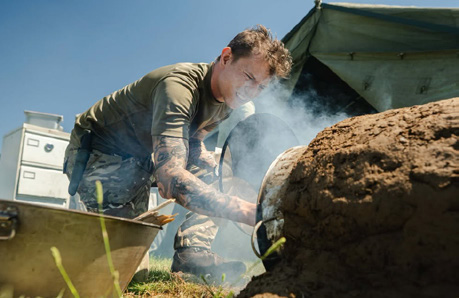
This was no genteel cookery display. The exercise brought together 15 competing teams from across the United Kingdom and overseas, alongside more than 200 individual British Army Regular and Reserve chefs. They competed across 15 culinary and field catering categories, under the watchful eye of the judges – professional experts drawn from the civilian hospitality and culinary arts industries – led by head judge Major Jules Rann RLC and supported by prominent cake and sugar craft artist Ben the Cake Man and senior military food service figures like Command Food Services Warrant Officer WO1 Roger Hart.
The scale of the event gave it real energy. Major teams competed for the overall championship title, with personnel drawn from the wider British Armed Forces and visiting international delegations. Teams from the United States, Germany, Oman, Lithuania and Qatar brought their own military catering traditions and methods to the field, making the exercise not only a contest of skill but also a lively exchange of professional practice.
Improvisation, Precision and the Art of Feeding Soldiers Well

What made the day so compelling was the contrast between the difficulty of the circumstances and the quality of the food being produced. The chefs were not simply cooking; they were planning, adapting, leading small teams, managing timings, handling unfamiliar ingredients and turning basic field resources into meals worthy of serious professional scrutiny.
The tactical and field cooking categories showed this at its most dramatic. In the Open Field Improvised Challenge, teams had to build their own wood-fuelled ovens or stoves from scavenged objects such as oil barrels, tyre rims and bricks, then cook a meal from a mystery box of fresh ingredients. It was half engineering, half cookery, and entirely dependent on calm judgement under pressure.
The Operational Field Kitchen Challenge tested a different discipline: deploying standard military mobile catering equipment to feed more than 20 personnel within strict operational timelines, using standard ten-man ration packs. The Parade des Chefs raised the stakes again, asking teams to prepare and cook a three-course meal for up to 84 seated diners. In each case, the challenge was not merely taste, but reliability, teamwork and the ability to deliver when failure would have practical consequences in the field.
The individual classes revealed the fine technical craft behind the military role. Poultry demanded knife skills and precision; fish required delicate handling and presentation; pasta called for creativity as well as sound technique; and the hot dessert category tested the control and accuracy of pastry work. Elsewhere, novelty cakes, celebration cakes and centrepieces showed the artistic side of the trade, with sugar craft, structural decoration and carving on display.

- Open Skills Poultry: Individual class testing technical precision, knife skills, and preparation of poultry dishes.
- Open Skills Fish: Individual class focused on the delicate handling, preparation, and presentation of fish.
- Open Skills Pasta: Focuses on creative and technically sound pasta dish construction.
- Open Hot Dessert: Evaluates pastry techniques and precise hot dessert service.
Winners Who Proved Their Professional Edge
- Novelty Cake & Celebration Cake: Showcases intricate baking, sugar craft, structure building, and structural cake decoration.
- Centre Piece / Fat Carving: An advanced culinary artistry category testing detailed fat carving, ice carving, or buffet showpiece design
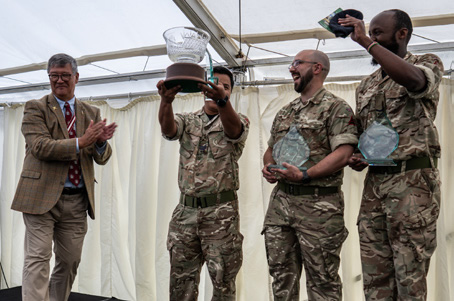
The awards underlined the breadth of talent on show. 26 Regiment Royal Artillery were crowned the overall Army Sustainer 2026 Champions, with their catering department taking first place overall. The 2nd Battalion, The Royal Yorkshire Regiment, also had an outstanding competition, collecting five major awards across individual and specialist classes.
Among the individual successes, Private Tueshumba Hepburn of 2 RYORKS won Junior Chef of the Year, Corporal Chris Finch of 2 RYORKS won the Open Skills Poultry category, Private Lalramzailawma of 2 RYORKS took the Open Skills Fish Dish category, and Lance Corporal Bryant of 2 RYORKS won Hot Dessert. Corporal Craig Lockie of 2 RYORKS secured bronze in Open Skills Pasta, while Lance Corporal Trask of 6 Regiment RLC placed third in Junior Chef of the Year.
Equipment, Innovation and the Reality of Field Catering

The event also drew notable joint and tri-service interest. RAF Wittering was represented by 3 Mobile Catering Squadron and 504 Squadron, a Special Reserve Squadron of the Auxiliary Air Force, both of which achieved strong marks across the field catering and culinary art brackets. Once again, however, there was no Royal Navy or Royal Marines participation, either as competitors or judges.
One of the most interesting aspects of the day was the German Army’s relatively new Futuretech container system. These modular kitchens have slide-out walls that expand to create a comprehensive food preparation facility. They are designed to operate autonomously in extreme climates, from the freezing Arctic Circle to intense desert heat, and are transportable on DROPS-equivalent lorries.
They are also, by common consent, impressively over-engineered: expensive pieces of equipment which some chefs still find less appealing than older, more familiar cooking systems.
A Trade That Deserves More Admiration
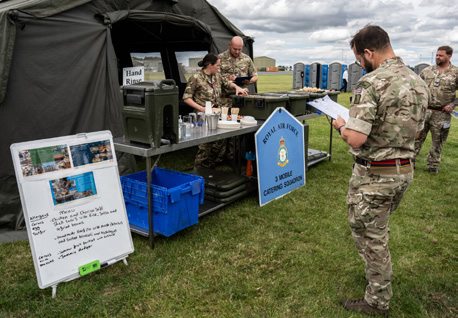
Several catering suppliers attended, covering catering services such as Aramark Defence, food suppliers and specialist catering equipment. Brigadier Richard Newland OBE, Commander of 102 Operational Sustainment Brigade, hosted the visit and gave valuable insight into the Army’s wider approach to logistics. Several of the UK Army chefs will no doubt have been identified as future members of the Army Culinary Arts Team, which will participate in the next Exercise Joint Caterer in 2027.
The day culminated in prize-giving at around 4.30pm, with some awards donated by the Company. It offered a powerful reminder that military catering is far more than background support: in the field, it helps sustain morale, reinforce discipline and showcase the ingenuity, resilience and professional pride of chefs working under the most testing conditions.


