
This year’s new grant from the Cooks Charity will continue to help Treloar’s strengthen specialist nutritional support for young people with complex dietary needs — and share that expertise far beyond its own school and college. What’s Cooking caught up with Nicola Doran, Livery Relationship Manager at Treloar’s to hear the latest plans.
There are few more powerful ingredients for independence, confidence and wellbeing than the right food, prepared in the right way, for the right person. At Treloar’s, where children and young people with complex physical disabilities are supported to learn, live and thrive, specialist nutrition is not an “extra” — it is central to quality of life. Thanks to the Cooks Charity’s approval of a new £25,000 grant, Treloar’s dietetic team will be able to continue developing this vital work at pace.
The grant has arrived at an important moment and it builds on a long-standing partnership between Treloar’s and the Cooks Charity, which has been in place for many years. Against a backdrop of financial pressure across the charity and care sectors, this latest support has helped Treloar’s grow not only its day-to-day provision, but also its influence: training future dietitians, building new partnerships, contributing to national conversations around blended diets, and helping more settings feel confident supporting people with complex nutritional needs.
Changing what is possible at mealtimes
For the young people and families who benefit, the impact is personal and immediate. One parent described how “Gracie now has a more varied diet because of the opportunities given to her at school during mealtimes.” Her mother added: “We truly believe that Treloar’s is the best setting for Gracie. Gracie is continuing to above and beyond what we ever expected.”
Those words capture the heart of the project. Specialist nutrition is about safety and clinical expertise, but it is also about variety, dignity, participation and joy. It means ensuring that young people can be included in the routines and pleasures of food, whether that is exploring new textures, joining friends at mealtimes, or building practical confidence in the kitchen.

Henry’s story shows this beautifully. In food technology sessions, accessible kitchen equipment has helped him grow in confidence. While making scones, he took charge of what he needed to follow the recipe and chose the big cutter to make large scones. His tutor noted that he is on a journey towards taking increased responsibility for organising and using items in the kitchen, while his mother said simply: “Henry has been so much happier since he moved to Treloar’s.”
Investing in the next generation of dietitians
One of the most exciting outcomes that the partnership with the Cooks Charity enables, has been the expansion of Treloar’s role in professional education. For the second consecutive year, Treloar’s delivered a guest lecture for the University of Surrey’s Nutrition and Dietetics BSc programme as part of its learning disability module. Treloar’s is the sole non-NHS contributor to that course, giving student dietitians valuable insight into how standard dietetic practice can be adapted for specialist and non-clinical settings.
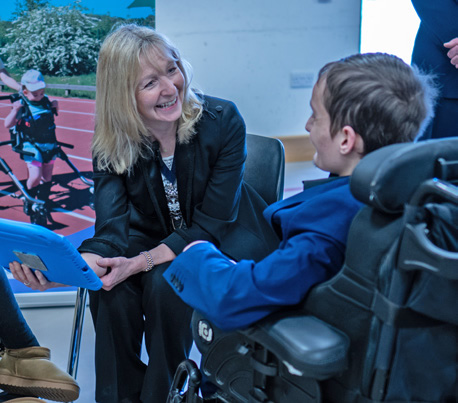
The benefit runs both ways. Students gain a broader understanding of clinical reasoning and the realities of supporting people with learning disabilities and complex needs. Treloar’s, in turn, helps raise awareness of its students’ nutritional requirements among newly qualified dietitians who will carry that learning into placements, employment and wider professional networks. The lecture has been so well received that it has now been incorporated into the university’s standing curriculum.
The team has also refined its approach to student dietitian placements. Following the first cohort in 2025, Treloar’s has identified that earlier-stage “B” placement students are likely to gain the greatest benefit from supervised, skills-based learning in its specialist setting. In partnership with the University of Surrey and Frimley Health NHS Foundation Trust, Treloar’s is planning to host two part-time students in September–October 2026, supporting them to develop practical skills such as taking detailed food histories, conducting anthropometric measurements and building therapeutic rapport.
Sharing specialist knowledge where it is needed most
Beyond Treloar’s own campus, the grant is helping the dietetic team influence wider practice through active engagement in the DISC network — Dietitians Interested in Special Children — which provides a valuable forum for sharing learning across specialist settings. The team has also been selected as one of six contributors to a British Dietetic Association round table on blended diet in diverse settings and the practical barriers to implementation.
This matters because one of the biggest challenges facing young people who rely on blended diets is transition. When students leave Treloar’s, suitable placements or care settings can be difficult to find, often because providers are unfamiliar with blended diet provision and perceive it as more complex than it needs to be. Treloar’s contribution to the BDA work will help develop practical operational guidance to sit alongside existing clinical guidance, covering areas such as equipment, staff training, nutritional content, recipes and implementation pathways.
A model that can travel
A practical example is already taking shape through Treloar’s partnership with Inspire Neurocare in Basingstoke. Inspire Neurocare is a specialist provider with an in-house dietitian and chef, and is working with Treloar’s to build confident, safe and sustainable blended diet provision. This is timely: one Treloar’s student is expected to transition there at the end of the academic year, with a further two to four students potentially moving on in July 2027.
The ambition is bigger than one placement. Once the approach is successfully embedded, Treloar’s plans to use the learning to create standardised documentation, placement processes and protocols that other settings can adopt. In other words, the Cooks Charity’s grant is helping create a recipe that can be shared — one that gives more organisations the confidence to support people with complex dietary needs wherever they live.
Purposeful philanthropy with lasting flavour
Treloar’s impressive work has helped strengthen professional education, expand clinical practice, deepen sector collaboration and advance specialist nutritional provision for people with complex dietary needs. It is the latest chapter in a valued relationship with the Cooks Charity that has lasted many years. Just as importantly, it has helped turn specialist knowledge into practical confidence for dietitians, care providers, families and young people themselves.
For What’s Cooking readers, it is a heartening reminder that food can be a route to inclusion, independence and opportunity. With the Cooks Charity’s support, Treloar’s is not only nourishing the young people in its care today; it is helping shape a more informed, capable and welcoming future for many more people with complex dietary needs.


